
What is « Pura Vida » Really?
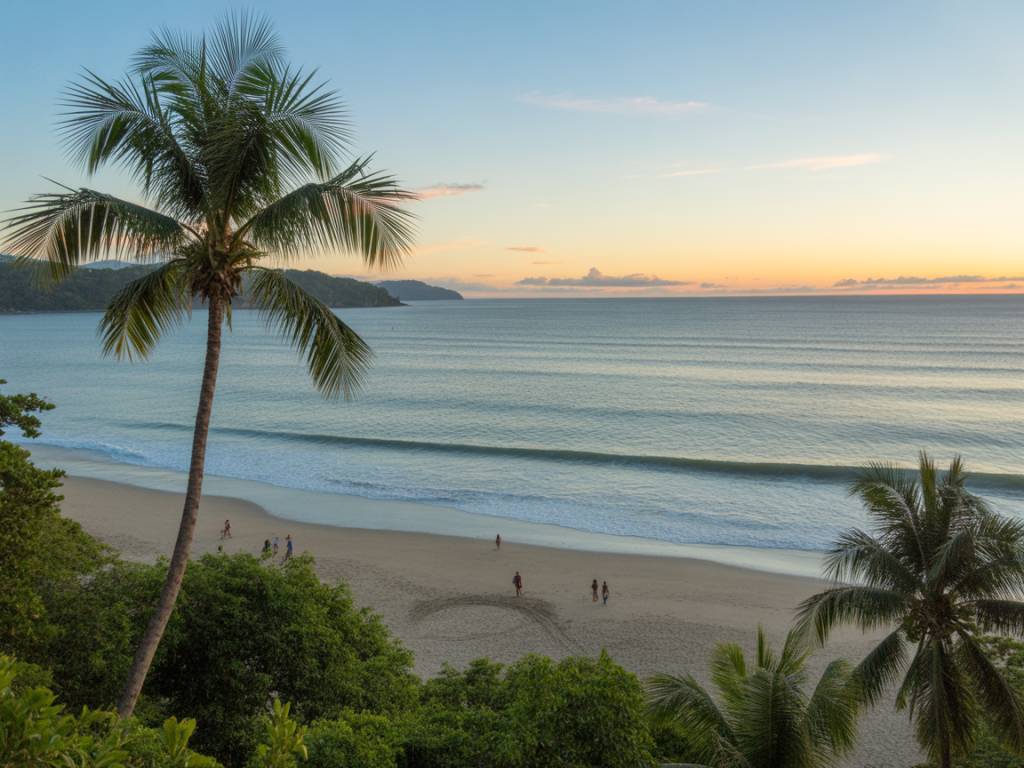
It rolls off the tongue like a friendly wave—“Pura Vida.” On the surface, it translates to “pure life.” But if you’ve spent even a handful of days in Costa Rica, you’ve likely sensed that this simple phrase carries more weight than its modest translation suggests. It’s not just something people say; it’s something they live. A beginner’s guide might start with a dictionary definition, but here, under the mango trees and between the waves of Playa Guiones, we learn what “Pura Vida” really feels like.
It’s a greeting, a farewell, a thank you, a you’re welcome. It’s the gentle shrug in traffic when someone cuts ahead. It’s the quiet ease of a morning coffee amid rainforest mists. “Pura Vida” is less a statement than a lens, a way of seeing the world softly, like golden light through a hammock’s weave.
The Roots of a Phrase, the Soul of a Culture
While the origins of “Pura Vida” are often debated—it appeared in a 1956 Mexican film before weaving its way into Costa Rican vernacular—it blossomed into something uniquely Tico. Why Costa Rica? Perhaps because this is a country that embodies the phrase in its every breath: no army, 98% renewable energy, and more protected nature reserves than roads. The phrase has found its nest in a space where simplicity, community, and balance aren’t aspirational—they’re foundational.
Pura Vida in Daily Life
If you’re new to Costa Rica, you might first encounter “Pura Vida” at the airport. A customs officer wishes you “Pura Vida” with a nod. Your taxi driver grins and says it after dropping you at your lodge. At first, you might smile awkwardly, unsure if it’s “goodbye,” “cheers,” or “life is good.” Spoiler: it’s all three.
Spend a week here, and the tape begins to rewind in real-time. You see it in the way Ticos linger in conversation, unhurried. In the cashier who doesn’t rush your transaction, because maybe you needed to chat about the rain. In the children playing barefoot in the plaza until the sun dances below the palms. There is space here—for breathing, for being, for belonging.
To live “Pura Vida” is to tune in to rhythm instead of schedule, to let nature sync your days rather than calendars. It reminds you to pause for sunsets and hummingbirds. And truly—can we ever be reminded of that too often?
Learning the Language of Slowness
As travelers, we often arrive with pockets full of impatience and itinerary points. But Costa Rica doesn’t rush to impress. It whispers. And if you listen closely enough—in the rustle of banana leaves, in the surf’s lazy sigh—you’ll start to hear what “Pura Vida” really sounds like.
I remember a morning in the hills above San Juanillo. A local farmer, Javier, welcomed me onto his land for a coffee he brewed over a wood-fired stove while his three-legged dog dozed on the porch. We talked about the rain, the soil, the trees. Not once did he check a clock. When I asked how long he’d lived on the land, he smiled and said, “Toda la vida… Pura Vida.”
It struck me then—it’s less a state of perfection and more a state of presence. The good, the messy, the unpredictable—taken as they are, with gratitude rather than resistance.
The Mindset Behind the Phrase
Adopting a “Pura Vida” mindset isn’t about becoming a tropical monk under a palm tree (although, let’s be honest, that’s not unappealing). It’s about making small mental shifts:
- Letting go of outcomes you can’t control.
- Appreciating everyday beauty—in food, in strangers’ kindness, in the late afternoon light.
- Choosing connection over convenience.
- Welcoming the unexpected with a smile, or at least a deep breath.
- Valuing experiences over efficiency.
Living well, not perfectly. Living slow, not stagnant. Living honestly, and kindly.
Pura Vida Isn’t Just for Ticos
One might be tempted to think of it as a romantic filter through which only locals can view their homeland. But travelers—especially those who immerse instead of hastily pass through—can carry a piece of it, too.
If you’re staying in Nosara or exploring Guanacaste’s quieter corners, you’ll quickly realize there’s a reason why many expats never left. The pace, the peace, the sense of shared humanity—these things stick to your soul like sand between your toes. You carry them home, whether « home » is Montreal, Berlin, or Melbourne. They nudge you at traffic lights and in grocery store lines. They show up in Friday night dinners cooked slowly instead of ordered fast. And just like that, you’ve got “Pura Vida” stitched into the lining of your everyday life.
How to Embrace Pura Vida as a Traveler
Getting the most out of your Costa Rican adventure doesn’t mean ticking off every waterfall and volcano. It means being open. Curious. Present. Here are a few gentle suggestions for travelers hoping to feel the hum of “Pura Vida” more deeply:
- Unplug More Than You Think You Should: That email can wait. The howler monkeys won’t.
- Speak With, Not At: Try your Spanish—no one minds errors when they’re wrapped in kindness.
- Support Local Everything: Eat where locals eat, shop artisanal, stay in ecolodges or family-run guesthouses.
- Shed the Rush: Missed the bus? Great! More time to taste that mango or stroll the beach.
- Listen Deeply: To stories, to music, to the forest. Costa Rica rewards those who show respect through stillness.
And if in doubt? Smile and say “Pura Vida.” It’s never out of place.
The Sustainable Side of Pura Vida
At its core, “Pura Vida” is deeply tied to sustainability—not the buzzword kind, but the real, root-deep kind that starts with respect.
Costa Ricans respect the land because it feeds them, shelters them, and inspires them. They’re among the world’s greenest people for good reason. Saying “Pura Vida” is, in a way, an acknowledgment of reciprocity—between humans and nature, visitor and host, past and present.
You’ll feel it when you visit a cacao farm that thrives without chemicals, or when a guide pauses a hike to pick up someone else’s trash. Here, caring isn’t trendy—it’s tradition. And it’s contagious.
Pura Vida Moments: The Ones You’ll Remember
No two people experience “Pura Vida” in the same way. For one, it might be a spontaneous surf lesson with a stranger who becomes a friend. For another, it could be a slow sunrise over unspoiled jungle, the world still wrapped in dew. For me, it was a quiet evening under a mango tree, a soft breeze, and nothing planned. There was no epiphany, no dramatic soundtrack. Just the comfort of contentment. The feeling that nothing was missing.
That’s the magic of “Pura Vida.” It’s not an escape—it’s a return. To rhythm, to humility, to joy found not in the exceptional, but in the every day.
So, Where Do You Begin?
You begin with a smile, a breath, and maybe a mango in hand. Come with less agenda and more openness. Trade expectations for wonder. Say “Pura Vida” not just with your lips, but with your pace, your choices, your presence.
And when you leave, try bringing a bit of it with you. Keep it tucked in a pocket of your mind for those moments when life rushes and roars. Whisper it to yourself like a promise: “Pura Vida.” It may be a small phrase, but trust me—it opens a very big door.